
At Frucor Suntory we’ve been working on transforming our Business Technology organisation from a predict-and-plan, systems-focused way of thinking and working to an Agile, human-centred way of thinking and working.
Starting our journey back in 2016, re-organising ourselves in 2017 and moving through numerous iterations since then, I’ll take you through the key steps at “20,000 feet” that we’ve taken to begin our transformation to an Agile service-provider organisation.
The steps below aren’t sequential, but rather represent ingredients that we’ve used and refined incrementally as we’ve progressed. We have made plenty of mistakes along the way, have plenty more to make and by no means have we “arrived”. As Gilbert Enoka would say “It’s a good start”.
Culture First
“Culture isn’t just one aspect of the game, it is the game.” -Lou Gerstner
The working environment that we co-create is both the foundation and the springboard that enables us to progress creatively and wholeheartedly into a new future, charting our path to success in a VUCA world.
Part of setting that environment was the creation of our social contract. At an all-team off site we co-created a social contract for how we wanted to work together and what behaviours we mutually expected of each other in a safe environment.
At the very heart of that social contract are the Modern Agile values. We live and breathe them and they form a basis on which we take action and approach work.
We are continually leaning into key aspects of cultivating and sustaining a healthy culture. In particular, as a Leadership Team we actively work to foster and embody psychological safety and equal voice. We believe these are absolutely core ingredients in creating the conditions for a culture of true high performance.
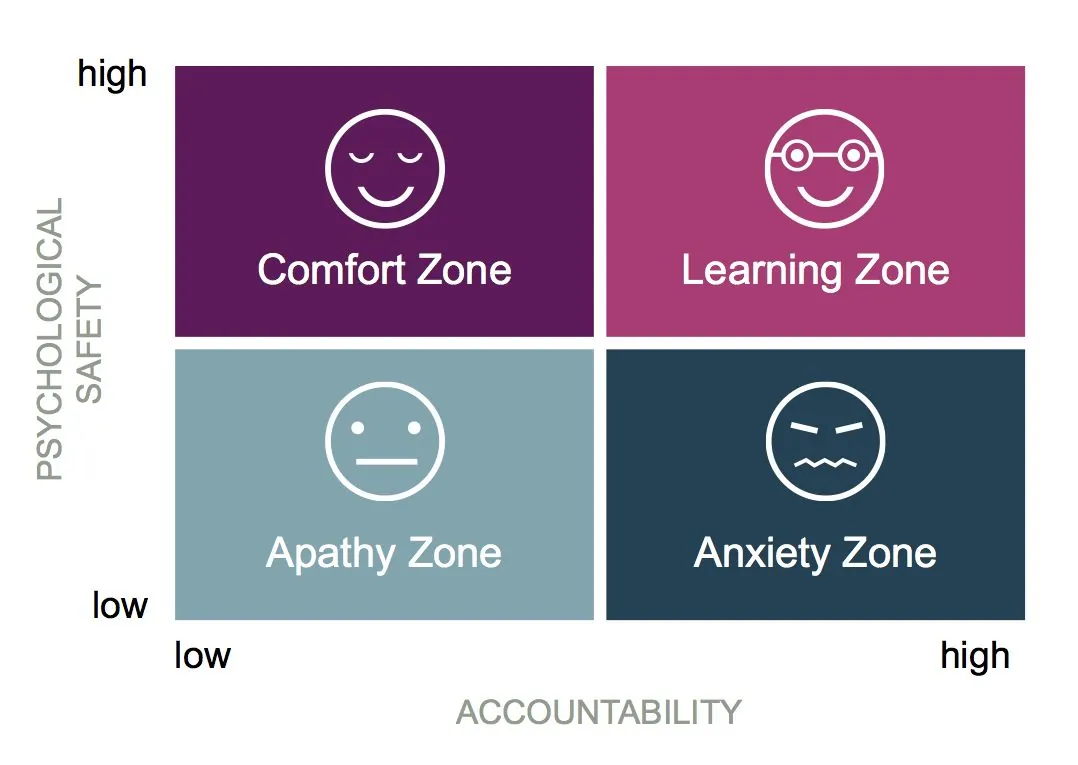
Psychological safety is where a large portion of our effort goes as we work on how we show up as a team (more reading on psychological safety here and here, with a quick Ted Talk here). We aim to mix high psychological safety with high personal accountability to target the high performance learning zone.
Human Centricity – Finding Out Who Our Customers Are and What They Want
“We see our customers as invited guests to a party, and we are the hosts. It’s our job every day to make every important aspect of the customer experience a little bit better.” -Jeff Bezos
In our effort to re-imagine the way we do business as a service provider we stepped back and asked ourselves the question: “Who is our customer?”
This led us to mapping our customer landscape and creating personas representing our customers and their contexts. In the process of doing this we also created our definition of a product:
“A set of goods and/or services used by a customer in order to solve a specific problem and/or satisfy a want or need.”
You’ll be surprise what products emerge when a product is defined in that way, from the perspective of a user solving a problem or satisfying a need.
This then created a solid frame for us to create the products of our Business Technology organisation. After creating an MVP version of our product-set we went through roughly a dozen increments before arriving at what we have today.
Below is a very early brainstorm/map we did on Miro to illustrate the thinking process. We are now about four major versions beyond this with a lot more consolidation and simplification
Value Streams for Managing Our Products
We created what we call “Value Streams” for managing our products. A “Value Stream” in our context is basically a portfolio of products. Each Value Stream portfolio has an investment and delivery roadmap that is co-created by a cross-functional group of technology, business and customer experience people.
The Value Streams are resourced by chapters of specialists along with product representatives (more on that in the Epilogue), subject matter experts and business process leads. Each Value Stream aims to deliver value in 2-4 week increments, with a bias to the shorter time-scale.
Below is one lens that can represent our operating model. The representation is insufficient to fully convey how we operate because the way we operate is more multifaceted and organic, but it provides a highly simplified view of our Value Streams and Chapters. Each Value Stream is responsible for both development and operation of their product portfolio.
We segmented our work into the four DevOps Work Types which you’ll see noted with the numbers 1 to 4 on the model above. The Work Types enable us to meaningfully categorise work so that we can focus on ensuring we optimise our ecosystem for value delivery and customer success while minimising repetitive work and eliminating waste (types 3 & 4). Below is a representation we use for our Work Types.
Governance
We built lean governance around our Value Stream product portfolios to ensure transparency, cross-functionality and ownership at all levels of the wider organisation we serve.
Each aspect of the governance model helps to serve the purpose of getting value to our customers and solving their problems to ultimately enable the commercial success of Frucor Suntory
Above is a representation of our governance setup. The boxes across the bottom in the diagram represent the cross-functional groups that co-create the product and portfolio roadmaps, and determine the lead and lag indicators that enable us to measure product success. We use Jeff Patton’s Outcomes and Impacts approach for product metrics with a focus on pay-to-learn cycles (mainly using Design Thinking for this) before we run pay-to-build cycles.
The middle boxes represent the cross-functional Value Stream Steering Groups (VSSGs) that as a collective body sense-check the roadmaps they create with their teams and gauge them against strategic direction. They allocate streams of funding into various products based on rolling strategic direction and as-needed tactical focus areas.
The box at the top involves our Frucor Suntory Executive Committee (CEO and direct reports) and serves the purpose of setting and allocating buckets of budget across Value Streams for maximum strategic benefit.
The box on the right represents the organisational agile coach role, responsible for coaching the process and the teams involved, facilitating the forums, and generally “holding the space” and keeping it healthy.
From a funding perspective we have implemented the Beyond Budgeting principles in the way we manage and fund across the product portfolios. The funding essentially enables a cross-functional capability that delivers value into one or many of our products.
Epilogue of Sorts
You may (or may not) be wondering whether we used Scrum or another notable Agile framework.
We decided early on that Scrum would not enable us to deliver the most value in our context, so we didn’t adopt it as a framework. We also didn’t adopt the common use of the role of Product Owner, instead opting for a product representative who brings to bear the Viability perspective of the Human Centered Design equation below. This brought about much more co-ownership, team engagement and holistic thinking. (See here for some further thoughts on that.)
Don’t Wait for Perfect
A mantra that you’ll hear more and more around Business Technology and increasingly around the wider Frucor Suntory organisation is “progress over perfection”. In a world that is ever-changing in very rapid fashion, “perfection” is an ever-elusive target.
Instead of aiming for the mirage of perfection, start somewhere, include everyone in the discussion and continuously improve as you go.
Next Up for Us
As for our journey, it could be summed up quite well in this way..
“Now this is not the end. It is not even the beginning of the end. But it is, perhaps, the end of the beginning.” -Winston Churchill
Originally posted on LinkedIn.